The Scoop
Upcoming EVENt
Scatter Vegan Sweets

Wendy Gabbe Day
Friday, Oct 29, 7pm, McNail-Riley House, 601 W. 13th (at Jefferson), Eugene. FREE - Map
Become a Member

Please visit our sponsors!
Click on their logos below.
Veg Spotlight













The Scoop > Articles > Various
There is not enough darkness in all the world to put out the light of even one small candle.
- Robert Alden
Must Read Articles
Various:
Oprah's Insight
Supporting Community and Local Agriculture
The Final Analysis
How Vegan? Ingredients vs. Activism
101 Reasons to Go Veg
Top Tips for a Dairy Free Thanksgiving
Is Man Carnivore, Omnivore or Herbivore?
Oregon Kids Getting Heavier, Study Says
Vegan Parenting Film
An Ethical Diet: The Joy of Being Vegan
Free Hugs Campaign
Happy Dancing!
Free Vegan Poetry
What Is Veganism?
The Bitter Truth About Chocolate
Veg 101 Quiz
Water - The Miracle Liquid
Water is a miracle liquid! "You need water to enable your body to keep eliminating toxic substances, to produce digestive enzymes, maintain healthy skin, hair and organs, and to help your body absorb essential vitamins, minerals and natural sugars. Water also regulates your body temperature, cooling you down by evaporating through your skin." - Alice Kavounas, Water Pure Therapy
"The correct daily amount of water intake is approximately one ounce of water per pound of scale weight." - Dr. Philip L. Goglia, Turn Up the Heat
Why Is Water Necessary?
"You're not sick; you're thirsty. Don't treat thirst with medication." Dr. F. Batmanghelidj
Everyone knows that water is needed by the body on a daily basis, but perhaps not the effects it can have when the body does not receive the amount of wter it needs. Low back pain, neck pain, asthma, hypertension, arthritis and colitis pain are just a few of the consequences as a result of chronic dehydration.
The human body is 25% solid matter and 75% water. Brain tissue consists of 85% water. The brain function takes absolute priority over all the other parts of the body. Even though the grain is only 1/50th of the total body weight, it receives 18-20% of the blood circulation. Because dehydration eventually causes loss of some functions ,the various signals put out by the body during severe and chronic dehydration have been translated as indicators of unknow disease conditions of the body. This is a basic mistake of clinial medicine.
Medical practitioners have been taughte to silence these signals with drugs. That only further damages the cells of the body and the signals of water shortage. If this is done often enough, permanent damage can result, which then passes on to subsequent descendents of the person. That is why certain diseases can seem to "run in the family."
Source: Your Body's Many Cries for Water by Dr. Fereydoon Batmanghelidj
Listen to answers Dr. Batmanghelidj gives to readers who pose some questions to him:
Q - If a person has been dehydrated for years, how long does it take to get rehydrated?
A - It may take several months. It is not just the dehydration that must be corrected, but the damage to the amino acid metabolism of the body.
Q - You mentioned in a private conversation that being chronically dehydrated can contribute to the formation of breast cancer. How is that?
A - First of all, chronic dehydration is a stress on the body. This would raise the level of the hormon prolactin, which has been known to incite breast cancer. Also, the dehydration would alter the balance of amino acids, and allow more DNA errors during cell division, another factor promoting breast cancer.
Q - How does water affect your sex life?
A - Water controls the changing shapes and positioning of molecules that escort hormones into the cells. When these hormones are in abundance, the sex drive is healthy and balanced. It is imperative that a person drink 8 glasses of water or more a day. When the body has an abundance of water, hormonal signals become stronger and the sex drive is strengthened. And if you live or travel in a hot area like Phoenix, you may need 18 glasses a day. Drink till your urine is clear.
Q - What about high blood pressure? A friend of mine had high blood pressure in spite of drinking plenty of water for many years. This friend had always denied herself salt, thinking it was bad foro her. Her doctor had put her on diuretics to control the high blood pressure.
A - A person needs 1-1/2 teaspoons of salt for ever eight glasses of water he drinks. If you deny your body the salt, it has difficulty retaining enough water, no matter how much you drink. Therefore, to make sure the system retains enough water, it raises the blood pressure. What this woman was doing was keeping herself in a state of dehydration, in spite of all the water she was drinking. The diuretics and lack of salt was creating --- not curing --- a continual high blood pressure.
[Note: Dr. B. is not suggesting here that you add salt to your water. There is an abundance of salt---usually too much---in the normal daily diet. Learn more about salt here.]
The Population Connection
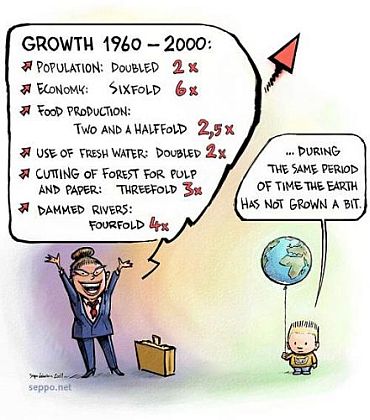
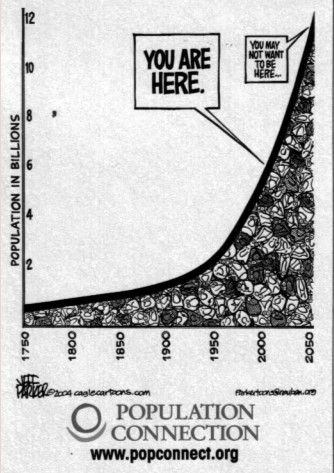
Population: World: 6,485,563,529 US: 297,891,356
Rapid population growth undermines efforts to reduce world hunger. A growing population consumes more space and resources, leading to a rapid loss of arable land and increased competition for remaining land. Our world is challenged to produce more food for more people on less land with less topsoil and fewer resources.
Today, an estimated 841 million people remain hungry and undernourished, a number that approaches the population of the entire world when Thomas Malthus warned about the race between food and people some 200 years ago. Currently, the livestock population in the U.S. consumes over 80% of our corn and 95% of our oats.
If Americans were to reduce their meat consumption by only 10%, it would free up enough grain to adequately feed all 60 million people who will starve to death this year. Population is not just about the number of people in the world. It's about how we each impact the Earth, how we consume, how we develop, and how we recognize our needs and our wants. Source: Zero Population Growth